Know which pages Google actually indexed.And why the rest didn't.
Seomely connects to Search Console, tracks every URL on your site, and keeps a permanent record of its index status. So when a page quietly falls out of Google, you find out the same week, not six months later.
Read-only Search Console access. We never crawl your site.
| URL | Status | 90-day history | Last checked |
|---|---|---|---|
| /blog/indexnow-vs-indexing-api | Deindexed 6 days ago | 2h ago | |
| /pricing | Submitted and indexed | 2h ago | |
| /guides/schema-markup | Recovered 9 days ago | 3h ago | |
| /blog/crawl-budget-guide | Crawled, not indexed | 2h ago | |
| /docs/api/authentication | Discovered, not crawled | 5h ago | |
| /careers/senior-engineer | Blocked by robots.txt | 5h ago |
Search Console shows you today. It never remembers yesterday.
Inspect a URL in Search Console and you get one number: its status right now. A page that was indexed for two years and dropped out last Tuesday looks exactly like a page that was never indexed at all. That single missing dimension is the difference between knowing and guessing.
A snapshot, one URL at a time
- ✕ No history. Yesterday's status is gone the moment it changes.
- ✕ No alerts when a page leaves the index.
- ✕ Coverage reports lag and sample, so small sites see nothing.
- ✕ One URL per inspection, by hand.
- ✕ No way to tell whether indexing is getting better or worse.
A continuous record of every URL
- ✓ Every observation stored, so you can see the exact day it broke.
- ✓ Alerts the moment an indexed page stops being indexed.
- ✓ Your whole sitemap, inspected on a rotation, every day.
- ✓ A plain-English cause and fix for every non-indexed state.
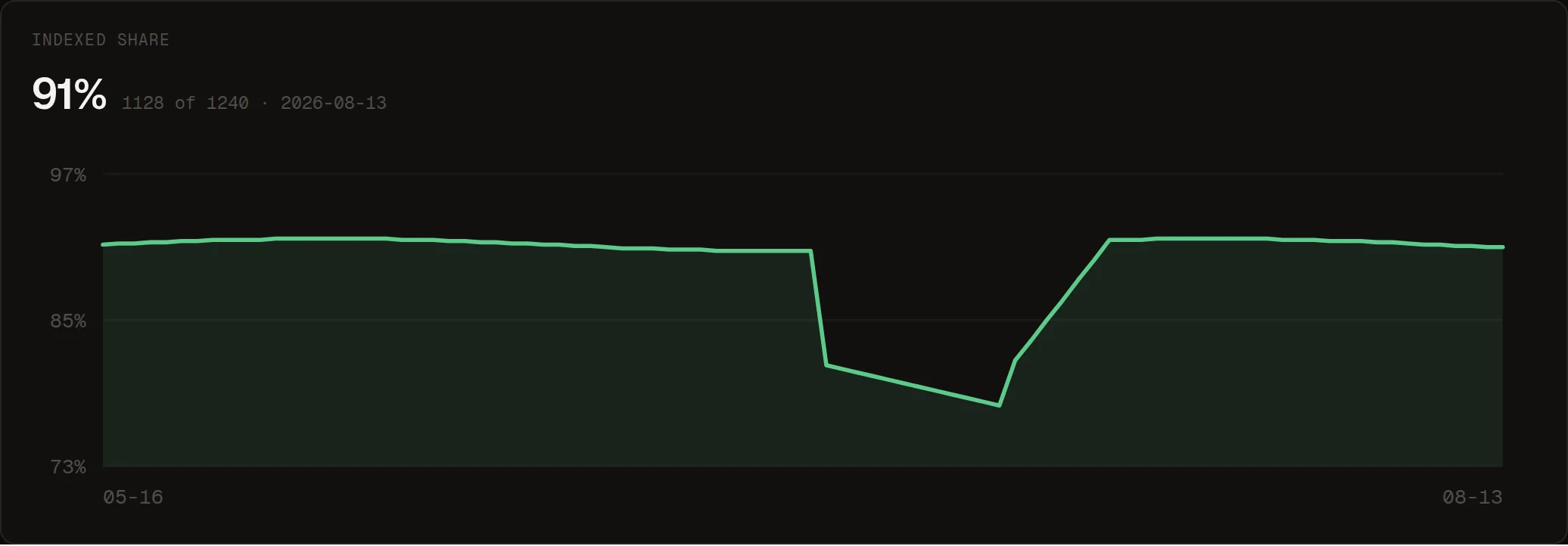
- ✓ Indexed share trended over 90 days, annotated with what moved it.
Four steps, then it runs itself.
Connect
Sign in with Google. We ask for exactly one scope, webmasters.readonly, so Seomely physically cannot change anything in your Search Console.
Inventory
We read your sitemap, follow nested sitemap indexes, and unpack gzipped ones. URLs that disappear from your sitemap get flagged, never deleted, because that is a signal too.
Inspect
URLs rotate through the URL Inspection API at up to 1,500 a day per property. Google's limit is 2,000, and we leave the rest for your other tools rather than quietly eating it.
Detect
Each result is compared with the one before it. A page that was indexed and no longer is becomes a critical alert that morning, not a number in a monthly report.
"Crawled, currently not indexed" is not an explanation.
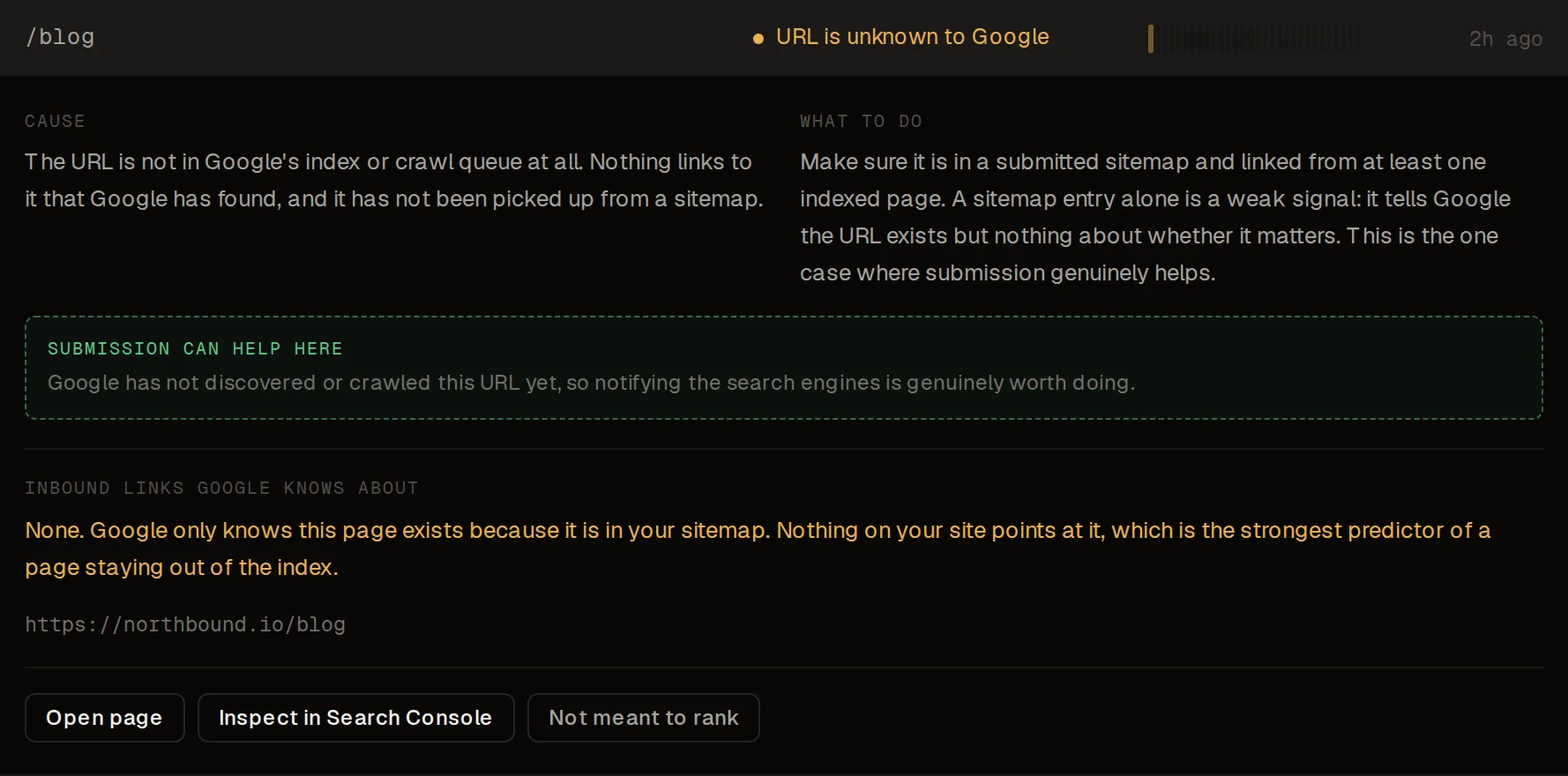
Google tells you the state. Seomely tells you the cause, the fix, and whether resubmitting would change anything. Usually it would not, and we say so.
Google fetched the page and chose not to index it. This is a quality judgement, not a technical fault. It is the most common reason real pages stay out of the index.
Strengthen the page: more substantial and distinct content, a clearer purpose, and internal links from related indexed pages.
Resubmitting the same content does not change a quality judgement. We will not waste your quota pretending otherwise.
Indexed for 12 days in June after an internal link was added from /blog/technical-seo, then dropped again when that link was removed.
Fourteen distinct causes, not one generic message
Robots blocks, noindex directives, soft 404s, redirect chains, server errors, canonical conflicts, duplicate clusters, and crawl-budget starvation each get their own explanation and their own fix.
It tells you when we cannot help
Every diagnosis carries an honest flag for whether submission could plausibly change the outcome. On most non-indexed states, it cannot, and pretending otherwise is how the rest of this category operates.
The history is the evidence
Because every observation is kept, a diagnosis can point at the day something changed and what changed with it, instead of describing the symptom you can already see.
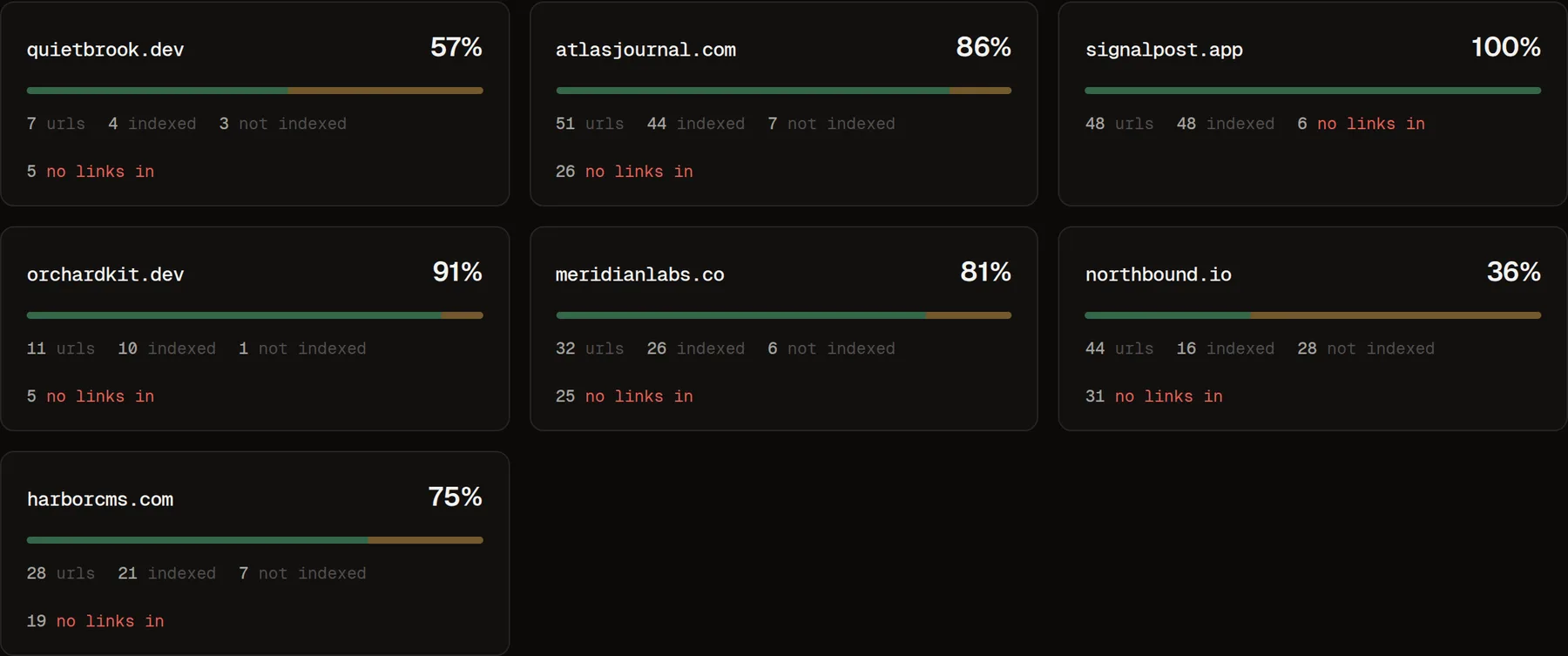
The pages nothing links to are the pages Google skips.
Google tells you which pages it found linking to a URL. We keep that, and the pattern is blunt.
of pages with at least one inbound link Google knows about are indexed
of pages with none are
Measured across every property Seomely monitors. Search Console has a Links report, but it ranks your most-linked pages. It never tells you that nothing at all points at a page, and never connects that to whether the page is indexed.
Find out the week it breaks.
Every inspection is compared against the previous one. State changes become events, and the ones that matter reach you by email the same morning.
Included. Just not oversold.
IndexNow, on every change we detect
When your sitemap gains a URL or a page changes, we notify the IndexNow network automatically. It is genuinely useful, it is instant, and it is the part of submission that actually works.
What we will never claim
Google's Indexing API officially supports two content types: job postings and broadcast events. Tools that pipe your blog posts through it are working outside Google's terms, and the access can be revoked.
Seomely does not do that, and does not promise to force anything into Google's index. We tell you what Google decided, when it decided it, and what would have to change. If a page is not getting indexed because it is thin, the honest product tells you that instead of selling you a submission quota.
Everything the dashboard does, your agent can do too.
The same index history behind the dashboard is available over a REST API and as an MCP server, so Claude, Cursor, or your own automation can investigate indexing problems directly.
$ curl https://api.seomely.com/v1/urls/unindexed \
    -H "Authorization: Bearer sk_live_..." \
    -d "project=example.com" \
    -d "since=30d"
get_unindexed_urlsEverything not in the index, with causescheck_index_statusCurrent state for any URLget_index_historyFull observation timelineget_regressionsPages that stopped being indexeddiagnose_urlCause, fix, and whether submitting helpssync_sitemapRe-read the sitemap nowsubmit_urlsNotify the IndexNow networkget_project_statsCoverage totals and trendAsk your agent "which pages stopped being indexed this month, and why?" and it has the data to answer properly.
You are handing us Search Console access. Here is exactly what that means.
It is a fair thing to hesitate over. So rather than a trust badge, here is the specific scope we request and the specific things we cannot do with it.
We request webmasters.readonly and nothing else. Write access is not in the token, so Seomely cannot change a setting, submit a sitemap, or remove a URL even if it wanted to.
We keep the URL and the index metadata Google returns: coverage state, canonical, crawl time, fetch status. We do not fetch, render, or store the page itself.
The only thing Seomely requests from your server is your sitemap file. Your pages are never hit by us, so we add nothing to your crawl load or your bandwidth bill.
Access lives in your Google account permissions, not ours. Revoke it there and every background job for your property stops the same day. Delete your account and the history goes with it.
Priced on URLs monitored, not on submissions sold.
- 1 property
- 500 URLs monitored
- 90 days of history
- Weekly inspection runs
- API and MCP, 1,000 calls a month
- 5 properties
- 25,000 URLs monitored
- Unlimited history
- Daily inspection runs
- Regression alerts by email
- IndexNow autopilot
- API and MCP, 25,000 calls a month
- 25 properties
- 250,000 URLs monitored
- Unlimited history
- Client workspaces
- Client-ready exports
- Webhooks
- API and MCP, 250,000 calls a month
- Priority support
Google allows 2,000 URL inspections per property per day and we use at most 1,500 of them, so your other tools keep their share. That means a property with 5,000 URLs is swept completely every four days, and one with 25,000 takes about two and a half weeks. Runs happen daily; each individual URL is re-checked on rotation. New pages and anything currently broken jump the queue, so the URLs you care about are checked far more often than the average suggests. Anyone promising daily checks on every URL of a large site is describing something the API does not allow.
A lifetime price makes sense for something you download once. This is not that. Seomely inspects your URLs every day, stores years of history, and has to keep working as Google changes its APIs. Those costs never stop, so charging once for them ends one of two ways: the service quietly degrades, or it disappears. A subscription is the version of this that can still be running in three years, which is precisely when your index history is worth the most.
Larger than the Agency plan, or need something specific? Email us and we will work out a plan that fits. A real person replies, usually the one who built it.
Your index history starts the day you connect.
There is no way to recover the months you did not measure. The best time to start recording is now.